Hi, RSU students,
The RSU Writing Center is a free resource and a place where you can find engaged readers who are ready to support you as a writer.
Remember, to make an appointment! You can have 2 appointments per paper assignment, and we don't
offer appointments on the assignment due date (though we will answer a few
specific questions if we have time)--so plan ahead.
Here are 3 optimal times to ask for feedback on an assignment:
1. When you receive the assignment sheet: we can help you make a plan for writing and help you make sure you're on the right track from the start.
2. When you have an outline or partial draft:
we can help you make sure you are on-track to meet assignment
requirements and help you make sure your outline/draft is shaping up to
be focused and unified.
3. 2-3 days BEFORE the due date, when you have a full or mostly-complete draft:
we can help you check to make sure your citations are correct and help
you check to make sure the writing is clear and concise.
Our schedule is filling up, so call, drop by, or visit rsuwc.setmore.com to reserve an on-ground, over the phone, or online appointment in advance.
Happy writing,
Sara
Tuesday, November 17, 2015

Wednesday, October 14, 2015
Advice from McKinze: Know Your Format!
In my recent appointments, I have noticed that many students
are unaware of the writing format required by their professors for certain
assignments. This is important because the format determines how the entire
paper is set up and how the in-text citations and works cited/bibliography is
structured. Most English, Writing, and
Humanities courses use MLA format, and most Communication, History, Political
Science, Psychology, Sociology, and Nursing courses use APA format. There are a
few courses at RSU that use Chicago or Turabian style writing, but those are
not as common as the MLA and APA utilizes courses. Many students also do not
know that the Writing Center offers templates for MLA, APA, and Chicago papers.
Those links can be found in the Writing Center section on the RSU page under
the Online Resources tab. Here’s a link: http://www.rsu.edu/academics/school-of-liberal-arts/department-of-english-humanities/writing-center/online-resources/.
Along with the templates, the Writing Center offers other resources that can be
beneficial to a specific format or the writing process in general. There are
links to websites that students can use to figure out how to cite sources in
specific formats and there are also links that help with proofreading
strategies.
While these resources are very helpful, it is most important
to understand how a particular professor wants a paper formatted. This is
important because knowing the format of the paper determines the structure,
citation format, and type of in-text citations, which can greatly affect your
grade if not done correctly. If you do not know for sure, ask them! You should
always keep an open line of communication with your professors and know that
they are there to help you. In the Writing Center, sometimes we do not know
what type of formatting a professor so it is difficult for us to help you if we
do not know the format. So always ask questions and know that there are many
resources that can help you figure out a specific format, and the Writing
Center is always here to help.
 |
| Source |
Monday, October 12, 2015
Advice from Hayden: The Start of the Process
Every writer—and yes, I do mean
every writer ever—has trouble with starting the writing process. Whether it’s
due to a lack of information, understanding, or willingness, beginning to write
those essays for class can be exhausting. In many of my consultations this
semester and even last year, students will schedule appointments and say
something like, “I’m not sure where to start,” or “I have no idea what I’m
doing.” Pre-writing can be difficult, but there are several ways to minimize
the pain and agony associated with starting an essay.
The first thing
you should do as you approach an essay is examine the assignment sheet. It’s
important that you not only answer the prompt but that you answer it in its
entirety. Oftentimes, professors will not simply ask you to answer one basic
question in an essay; it will be a much larger, broader topic that you will
have to come to some sort of conclusion about. Reading over the assignment
sheet can help you figure out what it is that you want to write about. What comes
to mind when you think about the assigned topic? It’s important to believe in
what you’re writing. The first thing that comes to your mind is often something
that you feel strongly about or have considerable feelings towards. It’s always
easier to write about things we feel strongly about, so go do it!
When you find
something you feel strongly about, the best thing you can do is to just start
writing. Forget all the rules (just for now) and write down everything you know
and feel about the topic. This is a great way to formulate your thesis. Kansas
University’s Writing Center provides great techniques that writers can use when
faced with pre-writing: http://writing.ku.edu/prewriting-strategies. A thesis is a
statement that is your opinion and how you can prove that opinion to an
audience. When you just sit down and write, you’ll find that the evidence to
prove your point is already in your head, just not on paper.
The great thing
about writing is that, although it’s never easy, we all have the ability to do
it and do it well. All it takes is a bit of willingness to start.
-Hayden
Wednesday, October 7, 2015
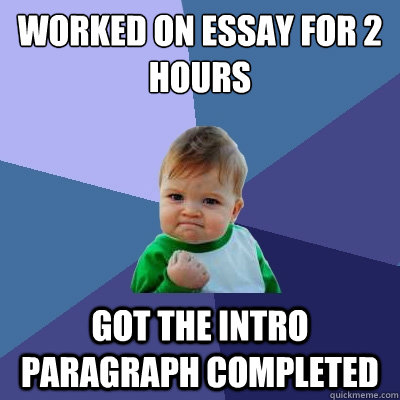
Advice from Michael: Tips on Starting an Essay
 |
| Source |
Lately, I have
had several students come in with no idea where to start on an assignment.
Sometimes this is a result of never writing a proper academic essay in high
school, and at other times they simply have always had trouble starting an
essay. To help them, I always start off with the same basic advice: remember
the five paragraph essay structure.
The five
paragraph essay structure will not always be helpful in college writing since
you will sometimes need significantly larger or shorter essays, but it is an
easy way to begin developing organized thoughts. For the intro, consider what
the overarching issue that is being addressed and then try narrowing that issue
down into the specific thesis statement you will be arguing. Then figure out
three arguments that can be made for what you want to say, and treat that as
the body paragraphs. Be sure to include these arguments in the thesis
statement. Finally, conclude everything, and be sure to restate the thesis without
adding new information in the conclusion.
Once you get at
least part of this information down, then start writing. You don’t even have to
start at the intro. You can begin with one of the body paragraphs if you
prefer, but getting the words and ideas down on paper tends to help the
students I’ve worked with gain a stronger grasp of what they are trying to
argue, and how they can argue it. As you continue along this path, the essay
structure can change to include more or less paragraphs or arguments as it
becomes apparent to the writer. More advice on paragraph structure and how to
structure an essay can be found on the Writing Center’s online resources under “Composition and Writing in the Disciplines” at this link. However, the
key to all of this is to simply trust yourself enough to start writing. Once
the words start falling on the page then everything will start to get easier.
Hang in there.
You’ll get it done eventually.
-Michael
Friday, October 2, 2015
Tessa on Thesis Statements

During my time at The Writing Center I’ve noticed that
students often struggle with creating, understanding, and identifying thesis
statements. In fact, this was once a challenge for me early in my academic
career. Your thesis statement is the most important part of your paper, and
identifying your thesis makes the writing process much easier. First, let’s
answer the question: What is a thesis statement? Basically, the thesis states
your claim or your reason for writing the paper. For example, if I was writing
a paper on the benefits of a university writing center my thesis might look
like this:
University writing centers offer many benefits to the
student body, faculty, and the university as a whole.
What I’ve done here is prepare my audience (the reader) for
my paper. I’ve told my reader what my paper will be about and what to expect.
But I’ve also obligated myself to fulfill this promise. By making this promise
to the reader, I hold myself accountable to write my paper in a way that
fulfills the reader’s expectations.
Keeping my thesis in mind helps me stay focused when I write
my paper. In my thesis statement, I claim that a university writing center is
beneficial for students, faculty, and the whole university, so I need to make
sure I address all three of my claims in the paper. One way I could to do this
is by developing a paragraph for each topic: how the university writing center
benefits students, how it benefits faculty, and how it benefits the entire
university. By doing this, my thesis is supported by the body of my essay, and
I fulfill my promise to the reader.
Once you understand what a thesis statement is, you can
better understand its mini-me, the topic sentence. The topic sentence does for
the paragraph what the thesis statement does for the essay. So, for my paper on
the benefits of a university writing center my topic sentence for the first
body paragraph might be:
Students in all majors and disciplines and at any level of
writing confidence can benefit by visiting the university’s writing center.
This topic sentence tells my reader that this paragraph is
about the ways in which students benefit from university writing centers. As
writers, what we are trying to say might make sense in our head, or even when
we read our paper, but it’s important to remember that our readers might need a
little direction. By developing a clear thesis statement and topic sentences,
we help readers understand where the paper is going, much like road signs help
us navigate the road.
For more tips on writing a thesis statement, check out the Purdue Online Writing Lab.
-Tessa
Friday, September 25, 2015
What do you think of the RSU Writing Center?
 |
| Image Credit |
How are we doing? RSU students, faculty, and staff can visit this link to tell us what we're doing well and what needs improvement:
http://goo.gl/forms/jsfmyxGVRr
(RSU login required to complete survey)
Thank you for taking a moment or two to tell us what you think. :)
~Sara
Monday, August 17, 2015
Book your Writing Center appointment online! <--UPDATED POST
Welcome back, RSU students!
The RSU Writing Center is open 8 a.m. to 5 p.m. on weekdays and provides assistance with writing from any major in 1000-level or higher courses.
We also help with resumes, cover letters, personal statements, etc.
We are now doing all of our scheduling online at this link: http://rsuwc.setmore.com/
You can log on with your RSU student webmail address (sdfirstnamelastname@student.rsu.edu) and password! Your student webmail is a Gmail account.
Whether you want assistance in person, over the phone, via email, or over Skype, you'll need to visit http://rsuwc.setmore.com/
Happy writing,
Sara
Subscribe to:
Posts (Atom)